Article Content
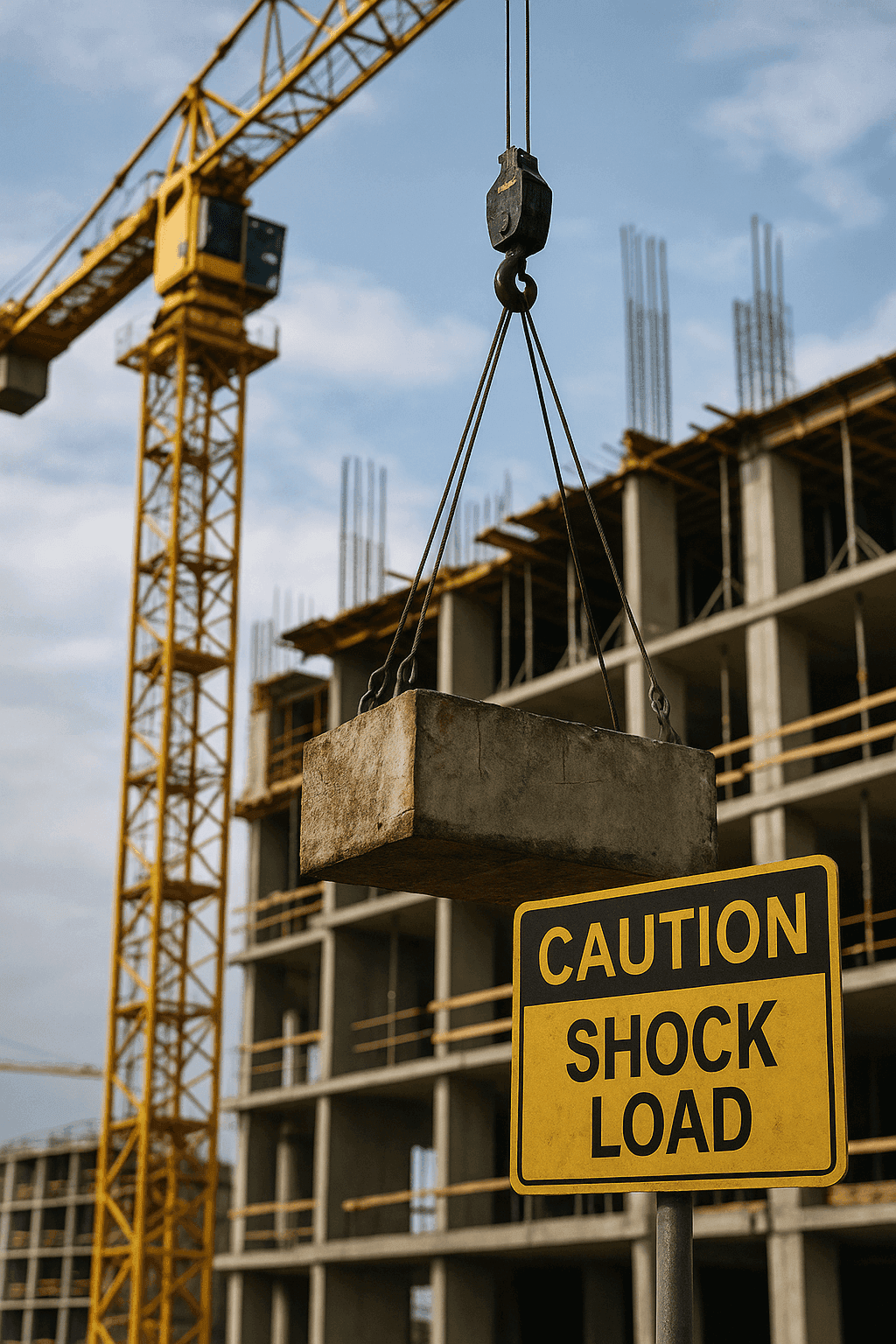
What is Shock Load? The Hidden Force That Breaks Cranes and Rigging
Most people involved in crane operations understand the concept of rated capacity: a 100-ton crane lifts 100 tons. What many don't fully appreciate is that the actual force acting on rigging equipment during a lift can be dramatically higher than the static weight of the load — sometimes by a factor of two or more.
This phenomenon is called shock load (also known as dynamic load or impact load), and it is one of the leading causes of rigging failures, dropped loads, and serious accidents in lifting operations worldwide.
After 30 years of crane operations across Southern Thailand, the team at S.K. Kunatham Group considers shock load prevention to be fundamental to everything we do. This article explains what shock load is, when it occurs, and how to prevent it.
What Exactly is Shock Load?
Shock load is a sudden, brief surge of force that occurs when momentum is abruptly transferred to or absorbed by rigging equipment or a crane structure. Unlike static load — the steady, predictable weight of a hanging object — shock load is dynamic. It spikes in milliseconds and can exceed the Working Load Limit (WLL) of equipment even when the actual weight of the load is well within rated capacity.
A simple analogy
Imagine picking up a 20 kg bucket of water:
- Lifted slowly and smoothly: your arms feel approximately 20 kg of force.
- Grabbed and jerked upward suddenly: the force on your muscles spikes — it feels much heavier for a fraction of a second, as if you picked up 35–40 kg.
That momentary spike is shock load. Now scale that effect up to loads of 10, 50, or 200 tonnes, and the implications become severe.
A 10-tonne load that experiences shock loading can create an instantaneous force of 15–20 tonnes or more on the wire rope, shackles, and crane hook. Equipment rated for 12 tonnes with a 5:1 safety factor suddenly faces forces it was never designed to handle.
Five Common Situations That Cause Shock Load
1. Jerking a slack sling taut
This is the most common cause. When rigging equipment hangs loose before a lift begins and the operator accelerates the hoist without first "taking the slack" (slowly tensioning the sling until the load is barely off the ground), the equipment goes from zero tension to full load tension almost instantaneously. The result is a massive shock load spike.
Prevention: Operators must always engage the load slowly — hoist until slings are taut, pause, verify the load is balanced, then continue the lift at controlled speed.
2. Pulling a stuck or snagged load free
When a load has been sitting on a surface for a period — a steel beam resting in rust or mud, a container partially sunk into soft ground — friction or adhesion holds it down. The operator increases hoist power to break it free. When the load suddenly releases, momentum causes a violent upward jerk that creates extreme shock on all rigging components.
Prevention: Before lifting, always check whether the load is adhered, frozen, or snagged. If it resists, investigate before applying more force.
3. Sudden braking during hoisting or lowering
If a load is being raised or lowered and the operator brakes suddenly, the inertia of the moving load continues to act even after the hoist stops. This deceleration force is transmitted through the rope and rigging as shock load.
Prevention: All hoist movements should decelerate gradually. Avoid emergency stops except in genuine emergencies.
4. Load swing — and sudden arrest
A swinging load that strikes an obstruction or is suddenly arrested stops abruptly, but its momentum continues. The rigging absorbs this energy as shock. Heavy loads in strong wind conditions, or loads moved by swinging the boom too quickly, are particularly vulnerable.
Prevention: Use taglines to control load swing. Limit boom travel speed when loads are suspended. Monitor wind speed and halt operations if conditions exceed manufacturer limits.
5. Unsynchronised tandem lift
When two cranes lift a single load together (tandem lift), if one crane moves before the other — even slightly — the stationary crane absorbs the entire load while the moving one takes close to zero. This sudden redistribution is a classic shock load event and can overload a crane operating at near-capacity.
Prevention: Tandem lifts require a detailed Lifting Plan, a single supervisor giving coordinated signals to both operators, and slow, synchronised movements throughout.
Why Shock Load is So Dangerous
1. It silently exceeds equipment ratings
Rigging equipment is rated for static Working Load Limits. Shock load creates dynamic forces that can exceed WLL without any warning — no alarm, no visual sign. Equipment may handle one shock load event without visible damage, then fail catastrophically on a subsequent lift.
2. It causes invisible internal damage
Wire ropes, shackles, and pad eyes may survive a shock load event but suffer micro-fractures or internal deformation that is impossible to detect visually. This is why shock-loaded equipment must be taken out of service and inspected — not just visually checked on site.
3. It invalidates your safety factor
Engineers specify rigging equipment with safety factors of 4:1 or 5:1 — meaning a 10-tonne sling is rated for 2-tonne lifts. A shock load of 1.5x or 2x the rated weight can consume the entire safety margin in a single event.
4. It creates the conditions for fatal accidents
A dropped load in an industrial environment — a port, a factory, a construction site — has lethal consequences. The sequence is predictable: shock load exceeds WLL → sling or shackle fails → load falls → someone is killed or severely injured.
How S.K. Kunatham Group Prevents Shock Load
Our Zero Accident record over 30 years is directly connected to how seriously we treat shock load prevention.
Operator training: Every crane operator we employ is trained to understand shock load — not just as a concept, but in terms of specific control technique. They know how to take the slack, how to feel the load before hoisting, and how to decelerate smoothly. This is reinforced at every pre-lift briefing.
Lifting Plans for critical lifts: For heavy, awkward, or tandem lifts, our engineers prepare a detailed Lifting Plan that identifies shock load risks and specifies the exact sequence of movements to manage them.
Equipment inspection and certification: All wire ropes, slings, and rigging hardware are inspected before and after each job and maintained according to manufacturer schedules. Any equipment subjected to a known shock load event is removed from service pending full inspection.
Real-time supervisor oversight: Our site supervisors watch every stage of a lift and have the authority to halt operations immediately if they observe risky operator behaviour — including fast starts, abrupt stops, or uncontrolled load swing.
Frequently Asked Questions
Q: Is shock load the same as overload?
No. Overload means the weight of the load exceeds the rated capacity throughout the lift. Shock load is a momentary force spike — the load itself may be well within rated capacity, but a sudden dynamic event pushes the actual force far beyond WLL for a split second. Both are dangerous. Shock load is more dangerous because it's invisible.
Q: Can I measure shock load in the field?
Not easily with standard equipment. Modern load cells with data logging can capture peak loads during a lift. The practical approach is to prevent shock load through controlled operator technique, not to measure it after the fact.
Q: What should I do if a shock load event occurs?
- Stop the lift immediately.
- Lower the load to the ground if it can be done safely.
- Remove all rigging equipment from service — do not visually inspect and continue.
- Document the event: what happened, when, what load, what equipment.
- Have rigging equipment inspected before returning to service.
Q: Does shock load affect all crane types?
Yes — mobile cranes, overhead cranes, tower cranes, hoists, and even manual chain blocks. Any lifting system can experience shock load if operated incorrectly.
The Bottom Line
Shock load is one of the clearest examples of why professional crane operations cost more than amateur ones. A trained operator who controls movements smoothly, takes the slack before every lift, and decelerates properly is not being slow — they are preventing the invisible force that breaks equipment and kills people.
Choosing a crane service provider is choosing the level of shock load risk your project accepts.
At S.K. Kunatham Group, we don't accept it.
Contact us for a free site consultation:
- LINE: @skgroup
- Phone: 074-333-074
- All 14 provinces of Southern Thailand