Article Content
Tandem Lift Explained: When One Crane Isn't Enough
Have you ever watched a bridge beam installation or a large industrial structure being erected and noticed two cranes working in perfect synchrony on the same load? That's a tandem lift — one of the most demanding operations in the crane industry, and one that requires a completely different level of planning, coordination, and expertise compared to a standard single-crane lift.
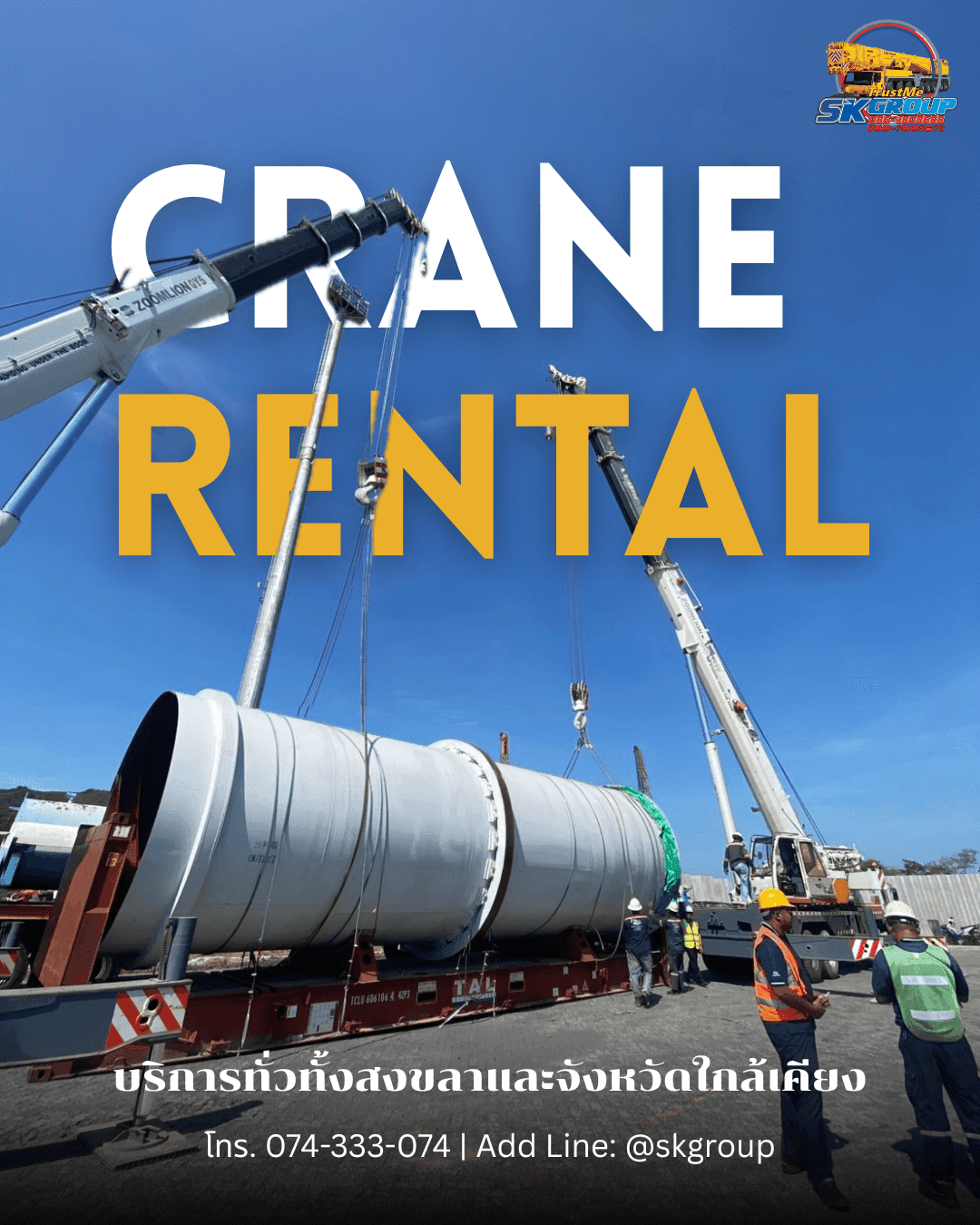
A tandem lift is defined as a lifting operation where two or more cranes simultaneously share the load of a single object. Each crane carries a portion of the total weight, and both must move in coordinated unison throughout every phase — pick, travel if required, and set-down.
At S.K. Kunatham Group, we've executed tandem lift operations across Southern Thailand for over 30 years — from port RTG crane assembly to bridge component installation to industrial overhead crane erection. This guide covers everything you need to know before planning one.
When is a Tandem Lift Necessary?
1. The load exceeds single-crane capacity
The most obvious reason. A component weighing 250 tonnes cannot be lifted by a 200-tonne crane. But rather than sourcing a 300-tonne crane from far away — with significant transport cost, mobilisation time, and road permit complications — using two 150-tonne cranes already positioned in the region is often faster, cheaper, and more practical.
This is especially relevant in Southern Thailand, where large cranes are stationed in Songkhla and Ranong. Avoiding long-distance crane transport by using a well-planned tandem lift with local equipment is a cost advantage our clients regularly use.
2. The load is too long for a single pick point
Structural members like bridge beams, roof trusses, and large-diameter pipes can extend 20–40 metres. Lifting such items from a single central point would cause bending stress that could deform or fracture the component. Two cranes positioned at each end distribute the load correctly and maintain the piece in a stable horizontal orientation throughout the lift.
3. Site constraints prevent a single large crane
In operating factories, port terminals, and dense industrial sites, space is often too restricted to position and operate a crane large enough to handle the load alone. Two smaller cranes, positioned strategically at separate access points, can achieve the same combined capacity while fitting into the available space.
4. Ground bearing capacity is insufficient for one large crane
Large crane capacity correlates directly with crane weight. A 500-tonne crane can weigh several hundred tonnes itself, with point loads under each outrigger pad that soft or compromised ground simply cannot support. Using two medium-capacity cranes distributes those loads across more outrigger points and reduces ground pressure to manageable levels.
What Makes Tandem Lifts Complex
Load sharing is not always equal
The load distribution between two cranes in a tandem lift depends on where each crane's rigging attaches relative to the load's centre of gravity. If the attachment points are not equidistant from the CoG, the cranes carry different proportions of the total weight. Each crane must be rigged and rated accordingly — you cannot simply divide total weight by two.
Both cranes must move as one
If one crane hoist moves 5 centimetres without the other following simultaneously, the entire load shifts to the stationary crane. At near-capacity loads, this redistribution can cause an overload event in seconds. Both operators must respond to a single set of coordinated signals from one supervisor — there cannot be two separate command authorities during a tandem lift.
Failure modes compound
In a single-crane lift, a mechanical issue affects one crane. In a tandem lift, a problem with one crane immediately affects the other — potentially simultaneously overloading it. The Lifting Plan must address contingencies: what happens if one crane has an emergency stop, how loads will be managed during an unplanned hold, and at what stage the load can be safely set down.
Communication is critical
All four crew members from each crane must operate as one integrated team. Radio communication between both operators, both signal men, both rigging crews, and the single overall supervisor must be clear, unambiguous, and continuous throughout the lift.
How a Professional Tandem Lift is Planned
A properly executed tandem lift begins with engineering — not with equipment. Before a single crane moves to site, the following must be determined:
Load analysis:
- Confirmed total weight and weight distribution along the load's length
- Centre of gravity location (verified, not estimated)
- Structural adequacy of the load to handle the lifting forces at the proposed pick points
Crane selection and positioning:
- Individual capacity of each crane at the required radius
- Crane positions relative to load and each other
- Outrigger positions and ground bearing calculations at each location
Rigging design:
- Sling types, lengths, angles, and WLL for each crane
- Use of spreader beams where required to spread attachment points or protect the load
- Calculated load on each crane under worst-case conditions (asymmetric CoG, one crane slightly higher than the other)
Communication plan:
- Designation of one supervisor for all lift commands
- Radio channels, signal conventions, and emergency protocols
- Defined hold points where both cranes must confirm status before proceeding
At S.K. Kunatham Group, all critical tandem lifts are planned by our engineering team with full documentation before work begins.
Common Questions from Project Managers
Q: Is a tandem lift more expensive than a single crane?
Yes — two cranes, two operators, two rigging crews, and extended planning time cost more than a single crane lift. However, the alternative — sourcing a single crane large enough to lift the load alone — often costs significantly more, particularly when that crane must be transported hundreds of kilometres, requires special road permits, and takes days to assemble on site.
Q: How much longer does a tandem lift take than a standard lift?
Planning typically requires 2–3 times more preparation. The lift itself may take 1.5–2x longer due to the controlled pace required for synchronisation. These timelines should be factored into project scheduling.
Q: How many cranes can be used in a tandem lift?
Technically, three or more cranes can share a load. In practice, complexity and coordination risk increase significantly beyond two. Triple-crane lifts require exceptional planning and are only used when there is no alternative. S.K. Kunatham Group has executed multiple-crane operations for specialised port and infrastructure projects.
Q: What is the safety record for tandem lifts?
Tandem lifts are statistically more likely to result in incidents than single-crane lifts — but this is because they are used for inherently more complex situations, not because the technique is inherently unsafe. With proper planning, certified equipment, experienced operators, and competent supervision, tandem lifts are routinely completed safely. Our 30-year Zero Accident record includes numerous tandem lift operations.
Tandem Lift Case Study: RTG Crane Assembly at Songkhla Deep Sea Port
One of our most demanding tandem lifts was the assembly of an RTG (Rubber Tyred Gantry) crane at Songkhla Deep Sea Port. RTG cranes are used to lift and stack shipping containers in port yards.
The project required:
- Two cranes working in coordination to erect the gantry structure in sections
- Precision placement of each component — tolerance measured in centimetres
- Full operational continuity of the surrounding port during the assembly
- Compliance with port authority safety protocols at every stage
The result: completed safely on schedule, with zero incidents, in a live port environment.
Planning a Heavy Lift in Southern Thailand?
If your project involves loads or dimensions that exceed single-crane capacity, or site conditions that make a large crane impractical, contact our team. We'll assess the feasibility, prepare a Lifting Plan, and provide a detailed quote — at no charge for the initial consultation.
Our tandem lift capabilities:
- Cranes from 25 to 300 tonnes: LIEBHERR, ZOOMLION, KATO, DMAG
- Engineering team for Lifting Plan preparation
- Coverage across all 14 Southern Thailand provinces
- 30+ years of specialised lifting experience
Contact us:
- LINE: @skgroup
- Phone: 074-333-074
S.K. Kunatham Group — Heavy lift specialists. Southern Thailand.