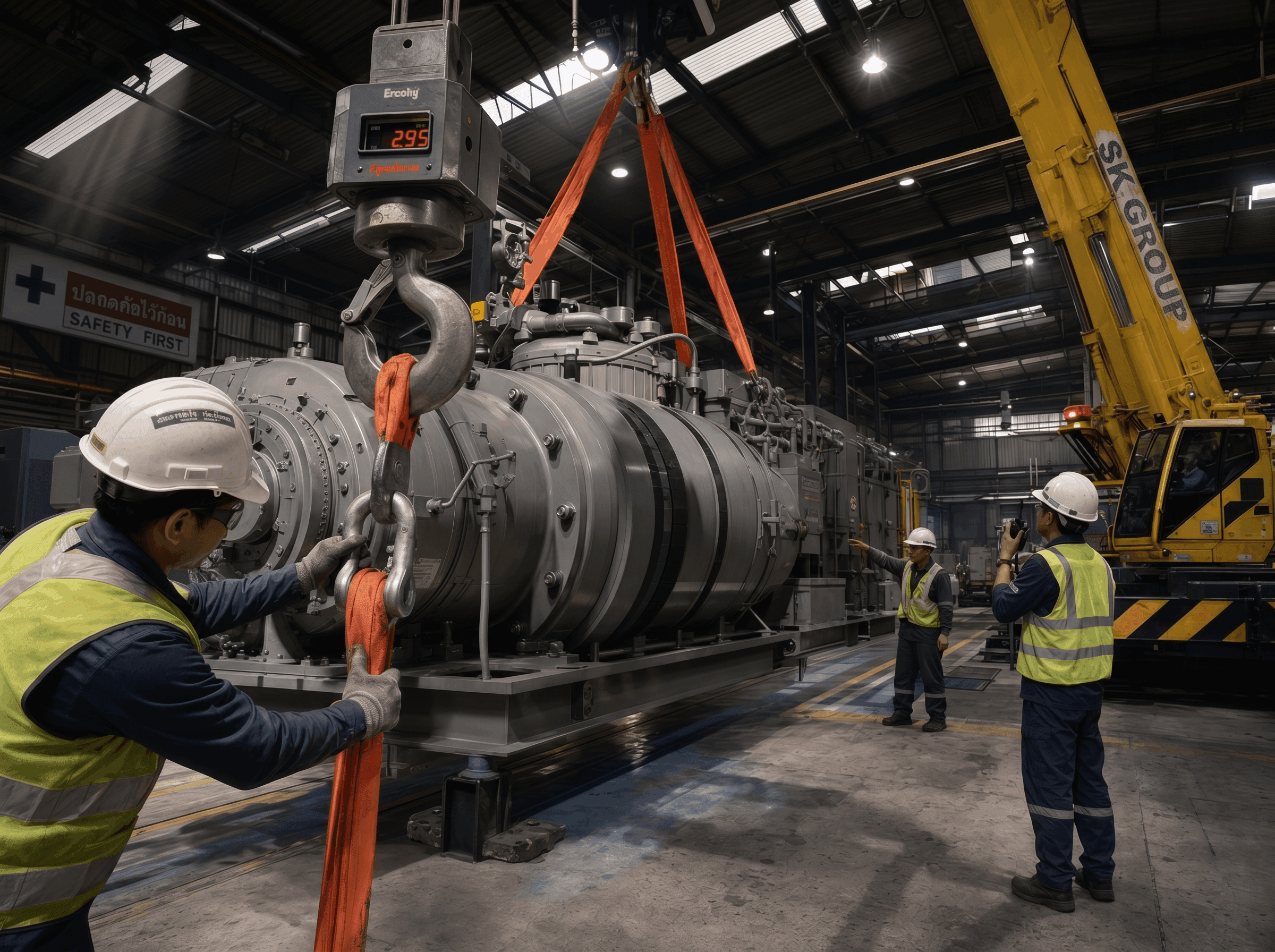
Article Content
Industrial Machinery Relocation in Thailand: A Complete Engineering Guide
Moving a production line, a CNC machining centre, or a 20-tonne compressor to a new location is not a logistics problem. It is an engineering project — one that requires careful planning, precise execution, and an understanding of Thai regulatory requirements that go beyond what most logistics contractors can provide.
Mistakes at any stage can result in irreparable damage to equipment worth millions of baht, serious injuries, production downtime that extends weeks beyond the planned window, and legal liability for failing to comply with Thai workplace safety law.
This guide is written for plant managers, project engineers, and EPC contractors responsible for machinery relocation in Thailand. It covers every phase from initial planning through to final commissioning, along with the engineering documents required, equipment options, and the ten failure modes that appear most frequently in machinery relocation projects.
Why Machinery Relocation Is Harder Than It Looks
Industrial machinery presents challenges that ordinary cargo handling does not:
Non-uniform weight distribution Most machines carry their mass unevenly — heavy motor assemblies, hydraulic reservoirs, and transmission components create a centre of gravity that is rarely at the geometric centre of the machine. Lifting without accounting for this causes the machine to tilt or rotate mid-lift, potentially beyond recovery.
Hidden sensitive components Precision bearings rated to micron tolerances, servo drives, CNC control boards, and optical measurement systems can be permanently damaged by shock loads that feel trivial to a person standing nearby. The machine may appear intact and start normally, but fail within hours under load.
Site constraints at both ends Doorway dimensions, ceiling heights, floor load capacity, utility connections at the destination — any one of these can block the relocation if not assessed properly in advance.
Production downtime cost Every hour a machine sits offline has a direct revenue cost. Poorly planned relocations routinely extend the planned downtime by 300% or more, costing far more than the relocation itself.
The Five-Phase Relocation Process
Phase 1: Planning and Assessment
This phase is the most important and the one most frequently compressed when project timelines are tight. Compression here always costs more time later.
Site survey requirements — both locations:
- Pathway dimensions: Measure every doorway, corridor, and stairwell through which the machine must pass. Include the narrowest point of each, measured with the door fully open and any door handles or closers accounted for.
- Ceiling height: Determines the maximum equipment height that can be used for lifting and transport.
- Floor load capacity: Factory floors are typically designed for distributed loads of 5–25 kN/m². Heavy machinery creates concentrated point loads at its base feet, which can be many times higher per unit area than the design load.
- Destination infrastructure: Is electrical supply at the right voltage, phase, and amperage? Is compressed air at the correct pressure? Are drainage connections in place? Are these verified — not assumed?
Engineering documents required before work begins:
| Document | Purpose |
|---|---|
| Rigging Plan | Specifies lift points, sling configuration, load distribution, and crane positioning |
| Load Calculation | Verifies total weight including fixtures, tooling, and residual fluids |
| Floor Load Capacity Assessment | Confirms both source and destination floors can handle the machine and transport equipment |
| Disconnection Plan | Documents every utility connection with photos, to enable accurate reconnection |
| Disassembly Plan | Step-by-step breakdown of components that must be removed before lifting, with labelling system |
| Safe Lift Plan | Required when lift load exceeds 75% of equipment rated capacity, or for any complex/multi-crane lift |
Phase 2: Disconnection
Disconnection must be systematic and fully documented. The documentation generated here is what enables accurate reconnection at the destination.
Shutdown and disconnection sequence:
- Purge process materials: Drain oils, coolants, hydraulic fluid, and any production materials remaining in the machine
- Pressure relief: Release hydraulic system pressure and depressurise pneumatic circuits before any lines are disconnected
- Apply Lock Out / Tag Out (LOTO):
- Electrical: Lock main isolator, apply personal lock and tag before touching any wiring
- Water: Close supply valve, drain lines, and lock valve
- Compressed air: Close supply valve, bleed residual pressure
- Gas: Close valve, verify absence with gas detector before proceeding
- Photograph before disconnecting: Every connection point — electrical, pneumatic, hydraulic, mechanical — photographed before removal. This is your reconnection reference.
Lock Out / Tag Out (LOTO) is a mandatory safety procedure that prevents any machine from being energised during maintenance or relocation. Under Thai workplace safety law, LOTO failure is an employer liability. It must be applied and verified before any work begins.
Components that must be removed before lifting:
- Control panels and HMI screens attached to the machine frame
- Sensors with vibration sensitivity ratings (laser interferometers, capacitive probes)
- Any protruding components that create clearance problems
- Counterweights (on certain machine types such as coordinate measuring machines)
Phase 3: Rigging and Lifting
This is the highest-risk phase and requires the most experienced supervision.
Accurate weight determination:
The weight used in lifting calculations must include:
- Machine base weight (from manufacturer documentation or shipping records)
- All fixtures and tooling attached to the machine at the time of the lift
- Residual fluid weight that may remain in hydraulic reservoirs or cooling circuits
A common error is taking the weight from the machine's nameplate without accounting for added fixtures, which can increase actual lift weight by 20% or more. This margin can push the required crane size into the next class.
What a Rigging Plan must specify:
- Lift points: Use only the manufacturer-designated lift points. Structural members that appear robust may not be designed to take vertical loads at all.
- Sling type and capacity: Synthetic flat slings, wire rope slings, or chain slings — each specified by type, width, and Working Load Limit (WLL)
- Sling angles: A sling angle of 60° from horizontal doubles the tension in each leg compared to a vertical lift. The Rigging Plan must show angles and the resulting effective WLL for the configuration
- Centre of gravity adjustment: How the lift points are positioned to accommodate an off-centre COG
When a Safe Lift Plan is mandatory:
- Load exceeds 75% of the crane's rated capacity at the required radius
- Tandem lifting using two or more cranes simultaneously
- Lifts in confined spaces or near live overhead lines
- Any lift where the operator cannot maintain direct visual contact with the load throughout
Phase 4: Transport and Placement
Equipment selection by situation:
Mobile Crane For loads that must be lifted out of a building, elevated to height, or moved where overhead crane rails do not exist. Mobile cranes offer the most flexibility in terms of working radius and lift height, at the cost of requiring adequate ground support and clear travel paths.
Overhead Crane (Plant-mounted) For short-distance moves within a facility equipped with overhead crane rails. Provides precise positioning with lower setup overhead. Cannot travel beyond the crane rail extent.
Machinery Skates / Roller Skids For horizontal movement of machinery on smooth, solid floors over short distances. Skates reduce friction and support loads from 1 tonne to 50 tonnes or more per set. No lifting is required — the machine is jacked slightly and skates placed underneath. More economical than crane-assisted movement when height clearance is not needed.
Dollies Platform units on wheels that provide four-corner support and allow directional changes. Rotating dollies navigate tight turns more effectively. Two separate jacking operations are required — onto and off the dollies. Best for mid-weight machines in constrained spaces.
Toe Jacks Short-stroke hydraulic jacks for raising a machine just enough to place skates or dollies underneath. Essential when the machine base has minimal ground clearance.
Self-Propelled Modular Transporters (SPMT) For extremely large, heavy, or structurally fragile equipment — power transformers, gas turbines, pressure vessels, large industrial modules. SPMT platforms consist of arrays of steered axle lines, self-powered by hydraulic drive, with active suspension to maintain level regardless of ground variation. Used when the equipment is too large or too heavy for conventional transport methods.
Securing during transport:
- Lateral restraint: Chain binders or ratchet straps sized to the machine weight, anchored to transport equipment structure — not to the machine's own components
- Vibration damping: Foam padding or vibration damping material between machine base and transport platform for precision equipment
- Tip prevention: Verify the height-to-base-width ratio against transport equipment stability limits
Phase 5: Reinstallation and Commissioning
This phase is often rushed because it comes last and the project team is fatigued. A poorly executed commissioning creates problems that appear weeks or months later, long after the relocation contractor has left.
Reconnection sequence:
- Level the machine using precision instruments (not visual estimation)
- Set mechanical connections — belts, couplings, drive chains
- Connect hydraulic lines (bleed air from circuits before pressurising)
- Connect pneumatic lines (verify pressure limits before opening supply valves)
- Connect electrical supply (verify wiring against disconnection documentation before energising)
- Connect control systems and sensors last
Minimum commissioning verification:
- Motor rotation check: Verify rotation direction for all motors before running under load. Reversed phase connection is the single most common commissioning error.
- Safety interlock function test: Every interlock — door guards, pressure relief, emergency stops — verified operational before production run
- Hydraulic pressure check: Confirm system pressure matches specification
- No-load test run: Listen for abnormal noise, measure vibration, check temperature at key points
- Partial load test: Run at 25–50% capacity before committing to full production
- Output quality verification: For machines where measurement is possible, confirm output quality matches pre-relocation baseline
Thai Regulatory Requirements
Occupational Safety, Health and Environment Act B.E. 2554
Requires employers to maintain machinery in safe condition, establish hazard zones around machinery, provide appropriate earthing for all electrical equipment, and conduct annual safety inspections for specified machinery categories.
Ministerial Regulation on Machines, Cranes and Boilers (2021)
Prescribes administration and safety management standards for machinery and lifting equipment used in the workplace. Includes requirements for machine guarding, inspection schedules, and operational safety systems.
Factory Act — Notification Requirements
If the relocation forms part of a broader factory move:
- Within 7 days of removing or relocating machinery, the operator must notify the Ministry of Industry
- If relocating to a new address, a new factory licence must be obtained — the licence is tied to the physical location
- Coordinate with the local Department of Industrial Works before resuming production at the new site
Floor Load Capacity: The Assessment Most Projects Skip
One of the most common contributors to machinery relocation failures is placing heavy equipment on floors that cannot carry it.
Industrial floor load ratings: Standard industrial floors are typically designed for distributed live loads of 5–25 kN/m² (approximately 500–2,500 kg/m²). This does not account for the concentrated point loads generated at machine base feet.
Example calculation: A 20-tonne machine with four base feet, each with a contact area of 0.05 m², generates: 5,000 kg ÷ 0.05 m² = 100,000 kg/m² at each foot
This far exceeds most floor design loads. The solution is to distribute the load using steel spreader plates or timber cribbing, increasing the contact area.
Floor assessment procedure:
- Obtain original structural drawings and check the design live load
- Inspect current floor condition for cracks, settlement, or deterioration
- Engage a structural engineer if drawings are unavailable or floor condition is questionable
- Where necessary, commission non-destructive testing (NDT) or a controlled load test using hydraulic jacks with deflection monitoring
Ten Mistakes That Cause Relocations to Fail
1. Compressing the planning phase Problems discovered during execution cost 5–10 times more to resolve than those found during planning. Allow 2–4 weeks for mid-size equipment, 2–3 months for large-scale plant moves.
2. Using nameplate weight without accounting for fixtures Added tooling, hydraulic fluid, and attached fixtures can increase actual lift weight by 20%+. Use load cells for critical lifts.
3. Skipping floor load assessment at the destination A floor that appears solid may crack or settle under point loads it was never designed to carry.
4. Not removing sensitive components before lifting Shock loads that seem minor to the rigger can permanently damage precision bearings, encoders, and control electronics.
5. Bypassing LOTO procedures Energisation of a machine during disconnection causes serious injuries. LOTO is not optional.
6. Not photographing connections before removal Without a photo record, reconnection at the destination becomes a troubleshooting exercise rather than a reconnection exercise.
7. Selecting a contractor on price alone An inexperienced contractor can cause irreparable damage to multi-million-baht equipment. The cost gap between the cheapest and most experienced contractors is small relative to the value at risk.
8. No Riggers Liability Insurance Verify that your contractor holds Riggers Liability Insurance (also called Inland Marine coverage) with limits that cover the full replacement value of the equipment being moved. General liability insurance does not cover lifted load damage.
9. Not aligning the machine after placement A machine placed without precision levelling will exhibit abnormal vibration, premature bearing wear, and accelerated seal degradation — none of which will be attributed to the relocation.
10. Energising before verifying utilities Wrong voltage, reversed phase, blocked coolant lines, or incorrect compressed air pressure can damage a machine in the first seconds of operation.
Pre-Relocation Checklist
Planning (2–4 weeks before)
- Site survey completed at both locations (access dimensions, ceiling height, floor condition)
- Structural drawings obtained and floor load assessment completed
- Total machine weight confirmed including all fixtures
- Rigging Plan prepared by qualified engineer
- Relevant regulatory notifications prepared (Factory Act)
- Riggers Liability Insurance confirmed with contractor
Day Before
- LOTO devices and tags staged and tested
- PPE confirmed for all personnel
- Machine pre-move condition documented with photos and video
- Spreader plates and cribbing prepared
On the Day
- Pre-work safety briefing completed
- LOTO applied and verified before disconnection begins
- All connections photographed before removal
- Sensitive components removed and packed
- Rigging hardware inspected before lift
- Machine secured before transport begins
At the Destination
- Level verified before reconnection
- Reconnection sequence followed
- No-load test run completed
- Commissioning report documented
S.K. Kunatham Group: Machinery Relocation Services in Southern Thailand
S.K. Kunatham Group provides heavy machinery relocation services across Southern Thailand, combining mobile crane capacity from 25 to 500 tonnes with transport equipment and a team holding 30 years of operational experience in the region.
Our fleet includes mobile cranes, HIAB truck-mounted cranes, and specialised transport for machinery relocation within and between industrial facilities at ports, industrial estates, and factory sites across all 14 Southern provinces.
For a site assessment or project consultation, contact our team via Line OA or call +66 74 333 074.
References: Occupational Safety, Health and Environment Act B.E. 2554 | Ministerial Regulation on Machines, Cranes and Boilers 2021 | Thai Factory Act | ASME B30 Safety Standard for Cranes, Hoists, and Rigging | ANSI/ASSP Z359 Fall Protection Code