Article Content
Boom Lift Rental Guide 2026: Types, Specifications, Safety Rules, and How to Choose
Whether you need to paint a 20-metre facade, service HVAC equipment above a factory production line, or install a large commercial sign on a building, a boom lift (aerial work platform) is almost certainly the most efficient and safest way to do it.
But "boom lift" is not a single machine type. There are three distinct categories — telescopic, articulating, and scissor — each with different reach geometry, load capacity, and site requirements. Selecting the wrong type means either an inability to complete the work, unnecessary cost, or a safety risk that the platform was not designed to manage.
This guide covers everything a project manager, site engineer, or facilities manager needs to know before renting aerial work platforms in Thailand: machine types, specifications, electric versus diesel selection, working height definitions, safety regulations, and certification requirements under Thai law.
What Is a Boom Lift?
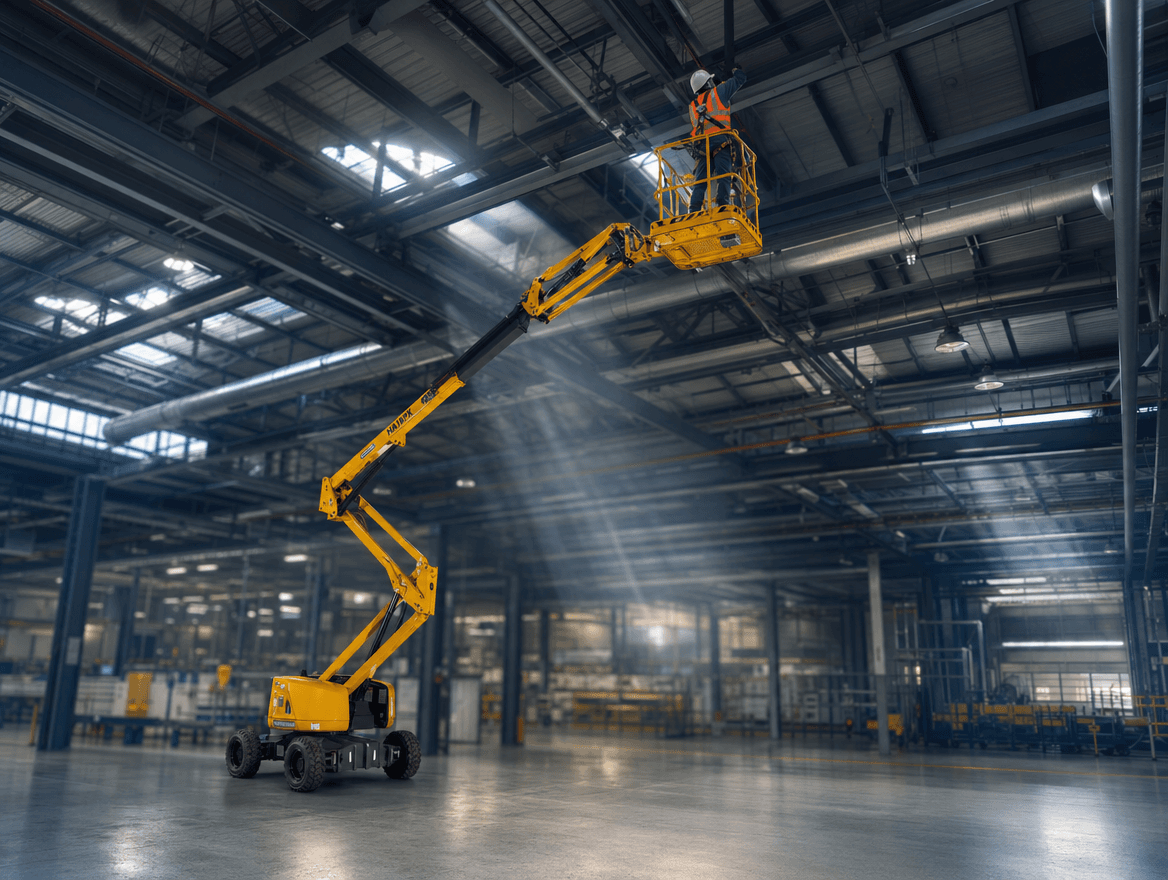
A boom lift (also called an aerial work platform or MEWP — Mobile Elevating Work Platform) is a machine that elevates a work platform to height using an extendable or articulating boom arm. The operator and tools ride in the platform basket at the end of the boom.
The key advantages over scaffolding:
- Repositionable without dismantling — move to a new position in minutes, not hours
- Horizontal reach — access areas overhanging obstacles that scaffolding cannot bridge
- Variable height — work at multiple elevations without rebuilding
- One-person setup — no team of scaffolders required for short-duration tasks
Three Machine Types: Core Differences
Telescopic Boom Lift (Straight Boom)
The telescopic boom extends as a single straight arm — like a telescope — providing maximum horizontal reach from the machine's base position.
Specifications:
- Working height: 12 metres to 60+ metres
- Horizontal outreach: Up to 20 metres at mid-height ranges (greater than articulating equivalents)
- Platform capacity: 200–1,000+ kg depending on size
Best applications:
- Open sites where the machine cannot be positioned directly beneath the work point
- Bridge and infrastructure work requiring long horizontal reach
- High mast and tower work requiring maximum height
- Facade work where the machine must stand at a distance from the building
Limitation: The straight boom cannot navigate around obstacles. If the work point is behind a beam, pipe rack, or structural element, telescopic reach is blocked.
Articulating Boom Lift (Knuckle Boom)
The articulating boom is divided into multiple sections connected by pivot joints — the "knuckles" — that allow the boom to fold and extend around obstacles.
Specifications:
- Working height: 10 metres to 46 metres
- Horizontal outreach: 7–15 metres (less than telescopic but with greater positional flexibility)
- Platform capacity: 180–300 kg for typical sizes
Best applications:
- Factories and process plants with pipe racks, overhead conveyors, and structural steel between the machine and the work point
- Work points that require approach from above and then horizontally — the articulating joint allows the operator to raise above an obstacle, then extend over it
- Indoor applications where aisle clearance limits straight-boom manoeuvring
- Any application where the direct vertical line to the work point is obstructed
Key advantage: The articulating boom can "reach over" obstacles — elevate above the obstruction, then fold the upper boom section to position the platform on the far side.
Scissor Lift
The scissor lift uses a pantograph mechanism to raise a large platform directly upward. Despite often being grouped with boom lifts, it operates on fundamentally different principles.
Specifications:
- Working height: 4–21 metres
- Horizontal outreach: None — vertical movement only
- Platform capacity: 250–1,500+ kg (significantly higher than boom lifts due to wider base support)
Best applications:
- Work requiring multiple workers simultaneously on the elevated platform
- Material handling — raising heavy components to installation height
- Warehouse and distribution centre maintenance
- Applications where the work point is directly overhead and no horizontal reach is required
Critical limitation: A scissor lift cannot position the platform beyond the machine's base footprint. If the work point is not directly above an accessible machine position, a scissor lift cannot complete the job.
Comparison Table: Telescopic vs Articulating vs Scissor
| Feature | Telescopic Boom | Articulating Boom | Scissor Lift |
|---|---|---|---|
| Maximum height | 12–60+ m | 10–46 m | 4–21 m |
| Horizontal reach | High (15–20+ m) | Medium (7–15 m) | None |
| Obstacle avoidance | No | Yes — excellent | No |
| Platform capacity | Medium (200–1,000 kg) | Low–medium (180–300 kg) | High (250–1,500+ kg) |
| Platform size | Small (1–2 persons) | Small (1–2 persons) | Large (2–4+ persons) |
| Best for | Open sites, long reach | Congested sites, factories | Vertical-only, heavy loads |
| Indoor use | Diesel: no / Electric: yes | Electric: yes | Electric: yes |
Electric vs Diesel: Matching Power Source to Site Conditions
Electric (Battery-Powered) Boom Lifts
Advantages:
- Zero emissions at point of use — safe for enclosed spaces: warehouses, factories, shopping centres, hospitals
- Quiet operation — suitable for environments sensitive to noise: hospitals, hotels, occupied office buildings
- No fluid leakage risk — protects finished floors from oil contamination
- Lower maintenance cost — fewer moving parts than internal combustion
Limitations:
- Battery runtime: Typically one full shift (8 hours) on a full charge. Overnight charging is required.
- Floor requirement: Electric machines are typically designed for smooth, hard floors. Performance on rough or soft ground is limited.
Diesel Boom Lifts
Advantages:
- Higher power output — superior performance on rough, uneven, or soft terrain
- Continuous runtime — refuel and continue; no waiting for recharge
- Higher payload capacity — diesel models typically carry more than electric equivalents
- All-terrain capability — appropriate for construction sites, outdoor industrial areas, and unprepared ground
Limitations:
- Prohibited indoors — diesel exhaust generates carbon monoxide, which accumulates rapidly in enclosed spaces to dangerous and potentially lethal concentrations. This is not a guideline; it is a categorical prohibition.
- Noise — diesel engine noise affects other personnel working nearby
- Floor contamination risk — potential for oil leakage on finished surfaces
Absolute rule: Diesel boom lifts must never be operated inside enclosed buildings or partially enclosed structures. This applies regardless of door openings, ventilation fans, or any other mitigation. Carbon monoxide is colourless and odourless — operators can lose consciousness without warning.
Working Height vs Platform Height: A Critical Distinction
These two terms are frequently confused and lead to wrong size selections.
Working Height (Maximum Working Height) The height at which a standing operator's hands reach — calculated as: platform height + 1.8 metres (average operator reach).
Platform Height (Maximum Platform Height) The height at which the platform floor sits when the boom is fully extended.
Example: A boom lift marketed as "20 metres" typically means 20 metres Working Height, which corresponds to approximately 18 metres Platform Height.
Before confirming your rental, specify whether you need 20 metres Working Height or 20 metres Platform Height — the difference is 1.8 metres, which can be critical for some applications.
Selection guide by building type:
| Building Type | Structure Height | Recommended Working Height |
|---|---|---|
| Single-storey residential | 3–5 m | 12 m minimum |
| 2–3 storey building | 6–10 m | 15–18 m |
| Industrial warehouse | 8–15 m | 18–25 m |
| 5–8 storey building | 15–25 m | 30–35 m |
| High-rise (10+ floors) | 30+ m | 40–60+ m |
The general rule: select a Working Height at least 2–3 metres above your highest work point to allow the operator a comfortable and safe working posture.
Wind Speed Limits and Environmental Restrictions
Wind is the most commonly underestimated hazard in boom lift operations. At 20 metres elevation, wind speed is substantially higher than at ground level, and the force on a platform carrying a standing person and equipment is significant.
General industry limit: Operations must cease when wind speed at platform height exceeds 12.5 m/s (45 km/h) — equivalent to the lower end of Beaufort Scale 6 (strong breeze). Many manufacturers specify lower limits; always verify the operator manual for the specific machine.
Observable indicators that wind is excessive:
- Large branches in constant motion
- The platform swinging visibly when stationary at height
- Difficulty maintaining a stable work position
Other conditions requiring immediate cessation of work:
- Lightning within the area — boom lifts present a tall conductive path
- Heavy rain reducing traction and visibility
- Ground conditions that have changed due to rain (soft or waterlogged ground)
Thai Certification Requirements: ปจ.2 and Operator Qualification
ปจ.2 for Aerial Work Platforms
Under Thai law, boom lifts are classified as mobile cranes (ปั้นจั่นชนิดเคลื่อนที่) — the same regulatory category as truck-mounted mobile cranes and crawler cranes.
This means every boom lift must hold a current ปจ.2 certificate, issued by a mechanical engineer registered with the Department of Labour Protection and Welfare, based on an annual inspection that includes a load test.
A boom lift with an expired ปจ.2 may not be operated legally. Before any rental commences, request and review the ปจ.2 documentation.
Operator Certification
Boom lift operators must hold training certification from an approved training provider. Under Thai law, this certification must be renewed every two years. The training covers:
- Machine operation and controls
- Risk assessment before and during operation
- Emergency descent procedures
- Working at height safety principles
Minimum Personnel Requirements
For any boom lift operation:
- 1 certified operator in the platform
- 1 ground person — responsible for observing conditions the operator cannot see, managing access controls around the machine base, and initiating emergency procedures if required
The ground person must be briefed on the operation plan and must remain in proximity to the machine throughout the work period.
Pre-Use Inspection Checklist
This inspection takes 10–15 minutes and must be completed before every shift. It is a legal requirement and a practical safety necessity.
Documentation
- ปจ.2 certificate current (verify expiry date)
- Operator manual present in machine
- Load capacity chart legible
- Operator certification current
Working Area
- Ground firm and level within manufacturer limits
- No overhead power lines within 3 metres of planned boom travel
- No floor openings or drainage gratings in travel path
- Adequate lighting
Structural Components
- Boom sections: no visible cracks, dents, or deformation
- All pivot joints (articulating models): no looseness or abnormal wear
- Extension mechanisms move smoothly without binding
Hydraulic and Power Systems
- Hydraulic oil, engine oil, coolant, fuel — all at correct levels
- No visible fluid leaks at hoses, fittings, or cylinder seals
- Battery fully charged (electric models)
- Tyres in good condition, correctly inflated
Controls and Safety Devices
- Emergency stop — tested at ground control and platform control
- Level indicator functional
- Limit switches operational
- Horn functional
Platform
- Guardrails intact, no damage or missing sections
- Gate or chain closure mechanism operates correctly
- Harness anchor points intact and rated
- Personal protective equipment staged: harness, lanyard, hard hat
Boom Lift vs Scaffolding: When to Use Each
| Consideration | Boom Lift | Scaffolding |
|---|---|---|
| Setup time | 15–30 minutes | Hours to days |
| Repositioning | Immediate | Must dismantle and rebuild |
| Short-duration tasks (<1 week) | Cost-effective | Labour cost exceeds benefit |
| Extended tasks (>1 month) | Accumulating rental cost | More economical |
| Access to irregular heights | Excellent | Fixed height |
| Access over obstacles | Yes (articulating) | No |
| Multiple workers at height | Limited | Yes |
| Heavy material handling | Limited | Yes (with hoists) |
For most single-trade maintenance, inspection, or installation tasks lasting up to two weeks, a boom lift is more economical than scaffolding when labour for erection and dismantling is counted. For multi-trade concurrent work over extended periods, scaffolding typically becomes the better option.
Eight Questions to Ask Before Renting
- Is the ปจ.2 certificate current? Request the document before agreeing to any rental.
- Is this machine electric or diesel? Critical for indoor applications.
- What is the Working Height vs Platform Height? Specify which measurement you need.
- What is the maximum platform payload? Include operator weight, tools, and any materials.
- What are the machine's overall dimensions and weight? To verify access through doorways and floor load capacity.
- Does the operator's certification cover this machine category?
- What is the breakdown response arrangement?
- Is there a minimum rental period, and what are the overtime rates?
S.K. Kunatham Group: Boom Lift Rental in Southern Thailand
S.K. Kunatham Group provides telescopic and articulating boom lift rental across all 14 provinces of Southern Thailand. Our fleet covers working heights from 12 to 60 metres, with both electric (indoor) and diesel (outdoor/rough terrain) options available.
Every machine we operate carries:
- Current ปจ.2 certification
- Certified operators with valid training records
- Full insurance coverage
Service areas include Songkhla, Hat Yai, Phatthalung, Satun, Pattani, Yala, Narathiwat, and Ranong, with deployment to all Southern provinces.
For equipment selection advice or to request a rental quotation, contact our team via Line OA or call +66 74 333 074.
References: OSHA 29 CFR 1926.453 Aerial Lifts | ANSI A92 Series Standards for Mobile Elevating Work Platforms | Thai Occupational Safety, Health and Environment Act B.E. 2554 | Thai Department of Labour Protection and Welfare