Article Content
The 4 Key Roles in Every Crane Operation: Who Does What and Why It Matters
If you work in construction, logistics, or large-scale industrial installation, you've probably heard that every crane lift requires a certified four-person team. But who exactly are these four people, and why is each role legally required?
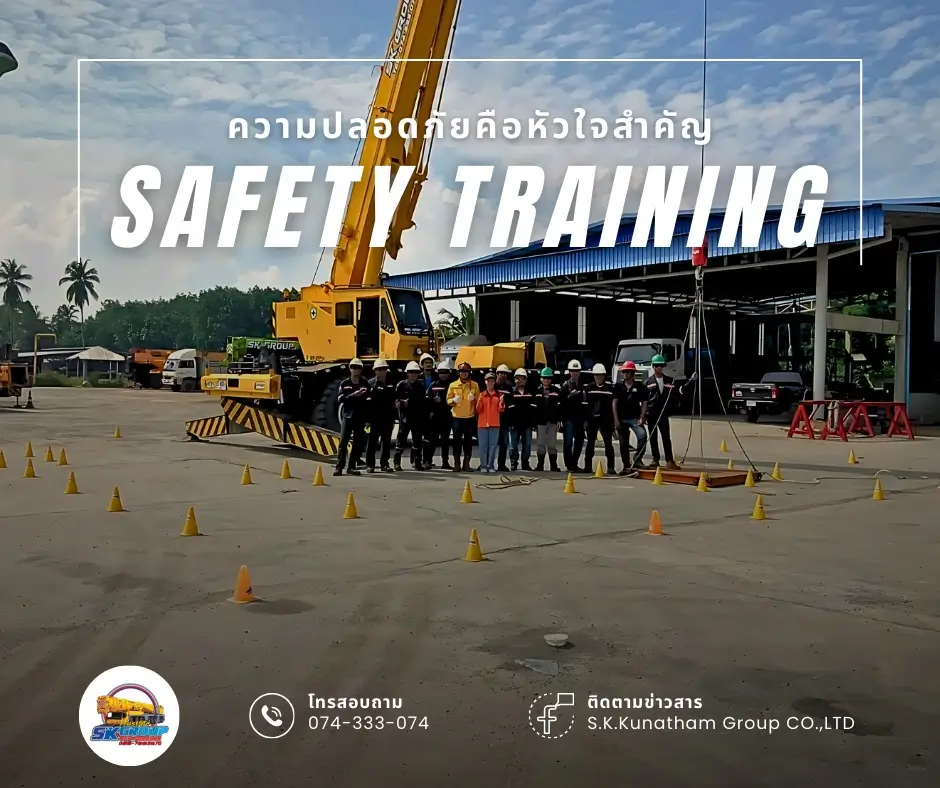
In Thailand, the Ministerial Regulation on Crane Safety (B.E. 2564 / 2021) mandates that all workers involved in crane operations complete certified training before performing their roles on site. This isn't bureaucratic formality — it's the baseline that keeps tens of tonnes of steel from becoming a disaster.
At S.K. Kunatham Group, we've operated crane teams for over 30 years across Southern Thailand. Here's a straightforward breakdown of each role, what they do, and why every project manager or site coordinator should understand the team they're hiring.
The Four Mandatory Crane Crew Positions
1. Crane Operator — The Pilot
The crane operator controls all movement of the machine. Their job is not just to drive — it's to manoeuvre a complex piece of machinery with precision, smoothness, and constant situational awareness.
Key responsibilities:
- Control the boom, hoist, and slew movements to execute the lift plan exactly as designed
- Work in continuous coordination with the signal man — they act on signals only, never independently during a lift
- Monitor the Load Moment Indicator (LMI) in real time to stay within safe limits
- Perform daily pre-operation checks and report any mechanical issues before work begins
An experienced operator understands that every movement has consequences. A jerk of the controls can cause a shock load that multiplies the effective weight on rigging equipment by 1.5–2x — a common cause of equipment failure and dropped loads.
2. Signal Man (Banksman) — The Eyes on the Ground
In a noisy, busy construction site, the crane operator often cannot see the load directly. The signal man is their eyes and voice on the ground. They relay all movement instructions using standardised hand signals recognised internationally.
Key responsibilities:
- Stand in a position where they can simultaneously observe the crane operator, the rigger, and the full path of the load
- Use precise, standardised hand signals — no improvised gestures
- Continuously monitor the surrounding environment for hazards: overhead lines, other workers, obstructions, wind changes
- Immediately signal STOP if any unsafe condition develops
A good signal man doesn't just relay commands — they actively assess the environment and act as the real-time safety checkpoint between the operator and the load.
3. Rigger — The Field Engineer
Rigging is physics applied under pressure. A rigger must understand load weight, centre of gravity, sling angles, and the working load limits (WLL) of every piece of lifting hardware they use. A mistake here can result in a load shifting, tilting, or dropping.
Key responsibilities:
- Assess the weight, dimensions, and centre of gravity of the load before selecting rigging equipment
- Choose the correct sling type (wire rope, webbing, chain), shackles, and attachment hardware rated for the job
- Calculate sling angles — a sling at 30° from vertical carries dramatically more tension than one at 60°, and selecting undersized gear is fatal
- Inspect all rigging equipment before and after each lift for wear, deformation, and certification validity
- Attach the load securely to the hook so it will hang level and stable
The rigger is often the last line of defence before the load leaves the ground. Their work must be right the first time.
4. Crane Supervisor — The Safety Commander
The supervisor plans and controls the entire lifting operation. They are responsible for everyone's safety within the lift zone, and they have the authority — and legal obligation — to halt work at any moment if conditions become unsafe.
Key responsibilities:
- Prepare or review the Lifting Plan: load weight, crane capacity at the required radius, boom configuration, outrigger positions, and exclusion zone
- Verify ground conditions can support the crane under full load
- Conduct a pre-lift Safety Talk briefing with the full team before work begins
- Coordinate all four team members throughout the operation
- Make final decisions in unexpected situations — weather changes, equipment anomalies, site interference
A competent supervisor is not just a paperwork role. They hold the overall picture when everyone else is focused on their specific task.
Why Certified Training Matters
The Thai regulation requires that each of these four roles be performed by a worker who has completed a government-approved training course for that specific position. The training standardises:
- Hand signal vocabulary — every team member reads the same signals the same way
- Hazard recognition — each person knows what risks belong to their role
- Legal accountability — certified workers and operators protect the project owner from liability if an incident occurs
Hiring a crane company that cannot provide training certificates for each of these four positions is a legal and financial risk for your project.
How S.K. Kunatham Group Staffs Every Lift
At S.K. Kunatham Group, we don't treat these four positions as boxes to tick. They are the foundation of our 30-year Zero Accident record.
- All crane operators hold current, valid operator licences
- Signal men and riggers hold certified training records renewed on schedule
- Supervisors have hands-on experience across dozens of project types — port operations, power plant installations, bridge assembly, industrial factory work
- We conduct a pre-lift briefing on every job, no exceptions
When you hire S.K. Kunatham Group, you get a complete, certified, experienced four-person team — not just a machine.
Ready to Start Your Project?
Whether you need a single crane for a day lift or a full multi-crane tandem operation over several weeks, our teams are deployed across all 14 provinces of Southern Thailand.
Contact us for a free site assessment and quote:
- LINE: @skgroup (fastest response)
- Phone: 074-333-074 (24/7)
S.K. Kunatham Group — Southern Thailand's crane specialist. 30+ years. Certified teams. Zero accidents.