Article Content
15-Point Safety Checklist Before Every Industrial Crane Lift
Lifting heavy machinery in an industrial environment is one of the highest-risk activities on any construction or plant site. Missed details don't produce near misses — they produce fatalities, multi-million baht equipment losses, and project shutdowns.
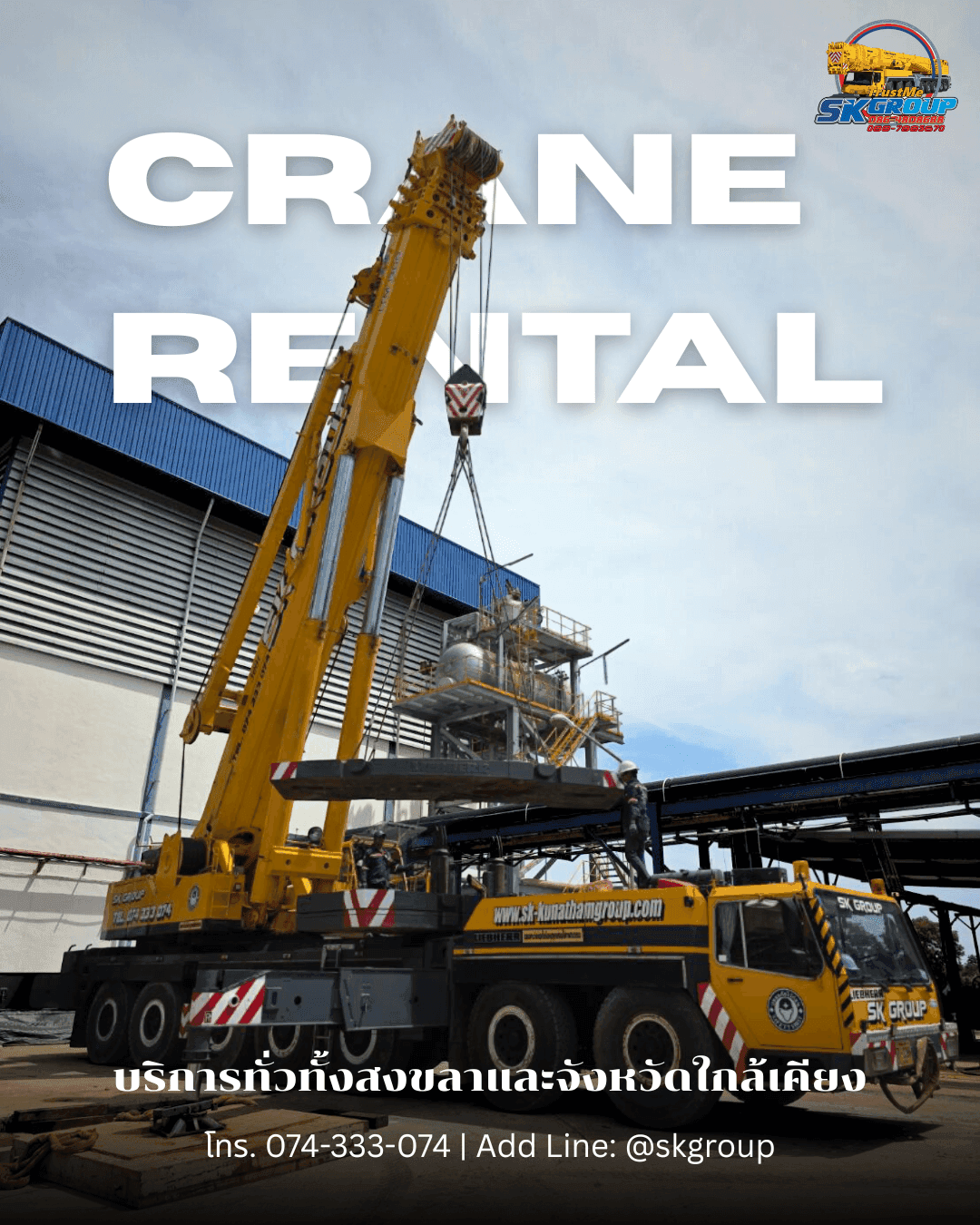
At S.K. Kunatham Group, with over 30 years of crane operations across Southern Thailand, we apply a structured pre-lift checklist on every single job. This is the same checklist our supervisors and safety officers run through before any lift begins.
Use this as a reference for your own site safety planning, or as a benchmark when evaluating crane contractors.
Section 1: Pre-Operation Planning
1. Work Permit (Permit to Work)
Confirm that a valid Work Permit has been issued and approved for the specific work area and lift scope. For operations within refineries, power plants, ports, or facilities with their own safety management systems, the permit must comply with the client's PTW procedure.
2. Lifting Plan
A written Lifting Plan must exist for every non-routine lift. It must include:
- Confirmed load weight (including all rigging attachments)
- Lifting radius from crane centre to load hook point
- Crane capacity at that radius (verified against the Load Chart)
- Boom length and configuration
- Outrigger positions and required bearing area
No Lifting Plan = no lift. This is non-negotiable.
3. Area Barricading
The lift zone must be clearly barricaded with physical barriers and warning signs. No unauthorised personnel should be able to enter the exclusion zone beneath or around the load path. This zone must extend to account for load swing under worst-case wind conditions.
4. Ground Conditions
The ground beneath each outrigger pad must be assessed for bearing capacity. Soft soil, recent backfill, drainage trenches, or underground utilities can cause outrigger settlement under load — the leading cause of crane tip-overs. Use certified steel outrigger pads sized to distribute load safely. If ground conditions are uncertain, a structural engineer must assess.
Section 2: Equipment Inspection
5. PJ. 2 Certificate (Annual Safety Inspection)
In Thailand, every crane must hold a current PJ. 2 (ปจ.2) certificate — the official government-issued annual safety inspection certificate. Ask for it before any crane arrives on your site. An expired certificate means the crane is operating illegally, and your project carries the liability.
6. Wire Rope Condition
Inspect the wire rope for:
- Broken wires (more than 10% in one lay length = remove from service)
- Kinking, crushing, birdcaging, or core damage
- Corrosion that pits the wire surface
- Diameter reduction greater than the manufacturer's limit
Wire rope failure mid-lift is catastrophic. Visual inspection takes two minutes and has no downside.
7. Hook and Safety Latch
The hook must not be bent, twisted, or show any cracks or deformation. The safety latch must spring closed firmly and lock without sticking. If the latch is worn or doesn't engage cleanly, the hook must not be used.
8. Safety Devices (LMI, Alarms, Limit Switches)
Verify that the following systems are functioning:
- Load Moment Indicator (LMI): real-time display and audible/visual warning at rated capacity
- Reverse alarm: sounds when crane travels in reverse
- Hoist limit switch: prevents over-hoist
- Anti-two-block device: prevents block-to-block contact
If any safety device is bypassed or defective, the lift must not proceed.
9. Rigging Equipment (Slings, Shackles, Spreader Beams)
All rigging hardware must:
- Display a legible Working Load Limit (WLL) tag
- Show no deformation, cuts, heat damage, or chemical damage
- Be within its rated inspection interval
- Be selected for the actual load, angle, and configuration of the lift
Webbing slings with cuts or UV degradation should be immediately removed from service. Shackles with worn threads or missing pins are scrap.
Section 3: Environmental Assessment
10. Overhead Power Lines
Identify all overhead electrical lines within and around the lift zone. Thai regulations require minimum clearance distances depending on voltage. If clearance cannot be maintained, the lines must be de-energised (obtain written confirmation from the utility) or insulated by a qualified electrician. Boom contact with a live high-voltage line is instantly fatal.
11. Wind Speed
Check the wind forecast before the lift and monitor conditions throughout. Most crane manufacturers specify a maximum operating wind speed (typically 10–13 m/s for mobile cranes, lower for tall boom configurations). If wind exceeds the limit, suspend operations. Do not attempt to "push through" marginal wind conditions with a large load.
12. Lighting
The entire lift zone, load path, and rigging area must have sufficient lighting. For night operations or work inside enclosed structures, temporary lighting must be installed and positioned to avoid glare into the operator's cab.
Section 4: Personnel Readiness
13. Operator Licence
The crane operator must hold a valid, government-issued operator licence appropriate for the crane category. Request to see the physical licence card — not a photocopy. In Thailand, licences must be renewed periodically and the operator must be on the crane company's registered roster.
14. Signal Man Present and Equipped
A trained, certified signal man must be present for every lift where the operator does not have full, unobstructed view of the load and its path. The signal man must:
- Wear a high-visibility vest distinguishable from other site workers
- Know and use the standard international hand signal set
- Have radio backup if communication distance requires it
15. Full Team Fitness and PPE
All crew members must:
- Have had adequate rest (fatigue is a leading human factor in crane accidents)
- Not be under the influence of alcohol or substances
- Wear a full complement of PPE: safety helmet, safety boots, high-visibility vest, gloves, and fall-arrest harness when working at height
A pre-lift Safety Talk (toolbox talk) with all four crew members present — Operator, Signal Man, Rigger, Supervisor — should be conducted immediately before the lift begins.
Safety is Not a Cost — It is the Project
Missing a single item on this checklist does not mean the lift will fail. It means you have removed one layer of protection from a system that needs all its layers intact. Accidents in crane work are rarely caused by one catastrophic failure — they are caused by the alignment of multiple small oversights.
The cost of stopping a lift to fix a ground bearing problem or replace a defective sling is measured in hours. The cost of not stopping is measured in lives and legal consequences that last years.
Working with S.K. Kunatham Group
When you engage S.K. Kunatham Group, this checklist is already built into our standard operating procedure. Every crane, every team, every job. Our 30-year Zero Accident record is the result of treating this checklist as mandatory, not optional.
We provide:
- All PJ. 2 certified cranes (25–500 ton fleet)
- Certified Operators, Signal Men, Riggers, and Supervisors on every job
- Lifting Plan preparation for complex or critical lifts
- Free site assessment before project start
Contact us:
- LINE: @skgroup
- Phone: 074-333-074
- Serving all 14 provinces of Southern Thailand